
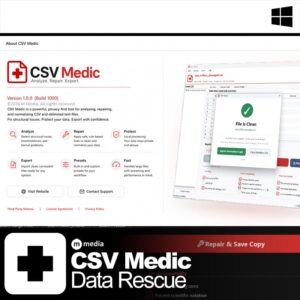
CSV files come out of legacy systems, billing platforms, ERP exports, and order feeds looking nothing like what your importer expects. Wrong encoding. Unmatched quotes. Rows with too many or too few columns. BOM characters in the wrong place. CSV Medic analyzes the file, identifies every issue by row, and repairs them in a single pass – locally, privately, with no cloud upload.
Encoding Repair – Detects UTF-8, UTF-16 LE/BE, Windows-1252, and ISO-8859-1. Converts to clean UTF-8, adds or removes BOM, and replaces garbled characters from legacy sources without corrupting valid data.
Structural Repair – Fixes unmatched quotes, inconsistent row lengths, and mixed delimiter characters. Pads missing fields and trims excess columns so every row matches the header exactly.
Excel Safety – Preserves leading zeros on ZIP codes and SKUs. Prevents scientific notation on large order IDs. Escapes formula injection characters so fields starting with =, +, -, or @ do not execute as formulas when opened in Excel.
Files over 64MB activate streaming mode automatically. CSV Medic never loads the full file into memory – it processes records one at a time and writes output to a new file in a single pass. The UI stays fully responsive. A repaired copy is written to disk. The original is never touched.
Presets apply a curated combination of repair options in one click. Excel Safe, WooCommerce Import, and Shopify Import are included. Save your own configuration as a JSON profile and reload it the next time the same broken format arrives – from broken file to clean output in under a minute, every time.
If a legacy system consistently exports rows with structural damage in the same positions, define a Column Break Rule once and save it to a profile. Every subsequent repair run applies the rule automatically – no manual intervention required.
CSV files contain customer records, order data, employee information, and financial details. CSV Medic processes everything locally. There is no cloud component, no account required, and no network access during repair. A timestamped backup of your original file is created automatically before any changes are written.
E-commerce operators running product imports for WooCommerce, Shopify, or eBay – and order exports from billing systems that fail the importer every single time without repair.
IT and operations teams handling legacy system exports heading into database imports or ETL pipelines. Files from vendors who have never heard of UTF-8. Weekly feeds that break every week.
Data analysts cleaning source files before loading into Excel, Power BI, or SQL – handling encoding garbage and structural damage before the analysis work even starts.
No subscription. No recurring fee. Buy once, use on your machine for as long as you want. Free updates through v1.x. Available exclusively through the Microsoft Store – purchase, installation, and automatic updates handled through the Store.
We don't believe in dark patterns, forced subscriptions, or holding your data hostage. M Media software products use clear, upfront licensing with no hidden traps.
You buy the software. You run it. You control your systems.
Licenses are designed to work offline, survive reinstalls, and respect long-term use. Updates are optional, not mandatory. Your tools don't suddenly stop working because a payment failed or a server somewhere changed hands.
M Media software isn't venture-funded, trend-chasing, or built to look good in pitch decks. It's built by developers who run their own servers, ship their own products, and rely on these tools every day.
That means fewer abstractions, fewer dependencies, and fewer "coming soon" promises. Our software exists because we needed it to exist — to automate real work, solve real problems, and keep systems running without babysitting.
We build software the way it used to be built: practical, durable, and accountable. If a feature doesn't save time, reduce friction, or make something more reliable, it doesn't ship.
This is software designed to stay installed — not be replaced next quarter.