
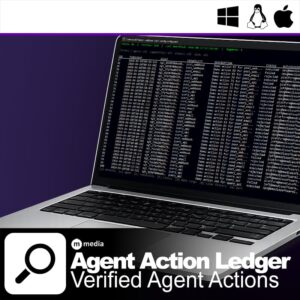
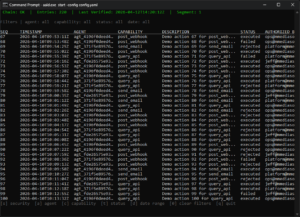
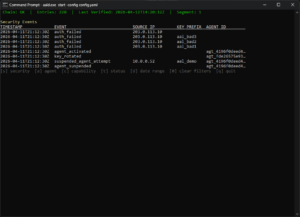
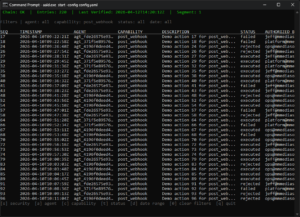
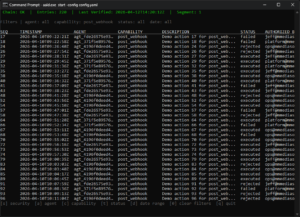
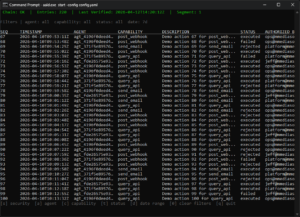
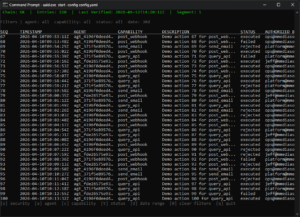
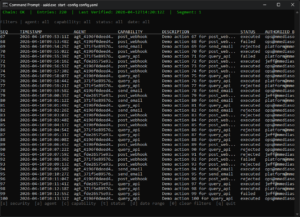
Agent Action Ledger stands between AI agents and the systems that can cause real-world consequences. Instead of letting agents touch SMTP servers, webhooks, internal APIs, or other sensitive integrations directly, it routes every action through a controlled execution layer where identity is verified, permissions are enforced, and the requested capability is checked before anything happens. That changes the security model in a meaningful way: agents do not operate on trust, intention, or best behavior. They operate inside a boundary you define. Every request is authenticated, evaluated against server-side policy, and executed only through approved pathways, giving operators a reliable way to control what agents are allowed to do before risk becomes damage.
Just as important, Agent Action Ledger makes accountability structural rather than aspirational. Each action is recorded in a tamper-evident chain that links request, authorization context, execution result, and ownership into a single defensible record. That means teams are not left stitching together traces from logs, third-party providers, and agent frameworks after the fact, hoping the story holds up under scrutiny. Sound familiar? They can see who acted, what was requested, whether it was allowed, what happened next, and whether the record has remained intact since it was written. For environments where legal review, compliance pressure, operational risk, or customer trust actually matter, that is the difference between “we think this is what happened” and “here is the verified chain of events.”
Your agents are already running. The records that do not exist yet are already not being written.
Agent actions are real-world risk, but most stacks treat them like app logs.
AI agents are now sending email, posting content, calling internal APIs, and triggering financial or operational workflows. Most teams rely on conventional logs and post-hoc reconstruction to answer basic audit questions:
In many environments, those answers are fragmented across orchestrator traces, app logs, and provider logs. That is not enforcement. That is hope.
Agents do not act once. They loop. Each iteration can touch real systems, trigger financial workflows, or modify shared state. The risk surface is not a single action – it is a running cycle of actions, each inheriting the permissions of the last. Without inline enforcement at the loop level, that cycle compounds silently. Some teams call deliberately engineering those agent cycles for control “loop engineering” – or in developer shorthand, “loopmaxxing.” Either way, the question is the same: who governs the loop? Agent Action Ledger closes this gap by making the control path and the evidence path the same path.
Proxy-first enforcement at every loop iteration, not advisory logging.
Agent Action Ledger sits inline between agents and capabilities:
If the capability is not granted, execution is rejected and recorded.
If the agent is suspended, execution is rejected and recorded.
If auth fails, the attempt is recorded in security events.
The agent never receives direct integration credentials, so it cannot bypass the gateway by design.
Accountability is derived, not asserted.
In many systems, an agent can submit a free-text requester field. That is not auditable authorization.
AAL derives authorization from registration ownership:
Agent agt_abc123 authenticated successfully, requested send_email, was granted send_email by policy, action recorded at sequence N, params hash logged, result persisted, chain verified.
No unverifiable requester string. No retroactive interpretation.
Built for teams that expect legal and compliance review.
Agent Action Ledger includes:
This is not blockchain marketing. This is practical, inspectable tamper-evidence with predictable operational behavior.
Native MCP tools without surrendering control.
AAL ships with an MCP server that exposes configured capabilities as tools.
That means a Claude-compatible agent can call your approved capabilities through MCP while enforcement still happens in AAL. Because MCP tool calls are stateless requests, each one is a discrete loop iteration. AAL enforces the same policy and ledgering flow on every call, regardless of how many times the same capability is invoked in a session.
MCP is the integration surface. AAL is the control plane.
One binary. Local storage. Immediate visibility.
No sidecars. No mandatory external control plane. No telemetry relay required.
Per-instance annual licensing. Enterprise-ready procurement.
Agent Action Ledger is licensed per instance, per year.
M Media Software Lab is a registered US vendor (DUNS and EIN on file).
$999.99
Annual license.
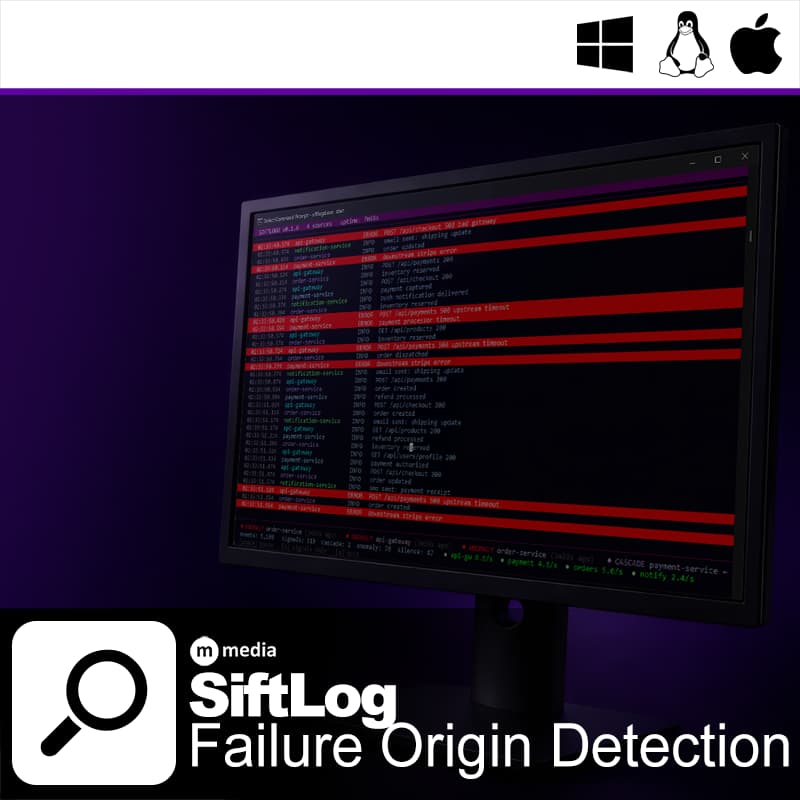
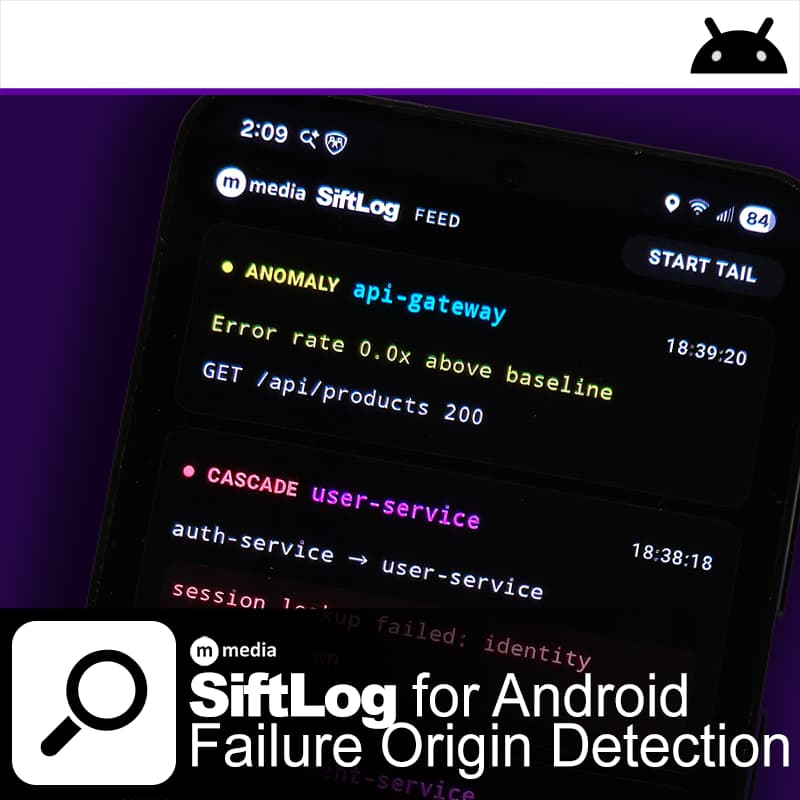
Modern software has become surveillance dressed as convenience. Every click tracked, every behavior analyzed, every action monetized. M Media software doesn't play that game.
Our apps don't phone home, don't collect telemetry, and don't require accounts for features that should work offline. No analytics dashboards measuring your "engagement." No A/B tests optimizing how long you stay trapped in the interface.
We build tools, not attention traps.
The code does what it says on the tin — nothing more, nothing less. No hidden services running in the background. No dependencies on third-party APIs that might disappear tomorrow. No frameworks that require 500MB of node_modules to display a button.
We don't believe in dark patterns, forced subscriptions, or holding your data hostage. M Media software products use clear, upfront licensing with no hidden traps.
You buy the software. You run it. You control your systems.
Licenses are designed to work offline, survive reinstalls, and respect long-term use. Updates are optional, not mandatory. Your tools don't suddenly stop working because a payment failed or a server somewhere changed hands.